Northwich u3a monthly meeting - April 2026
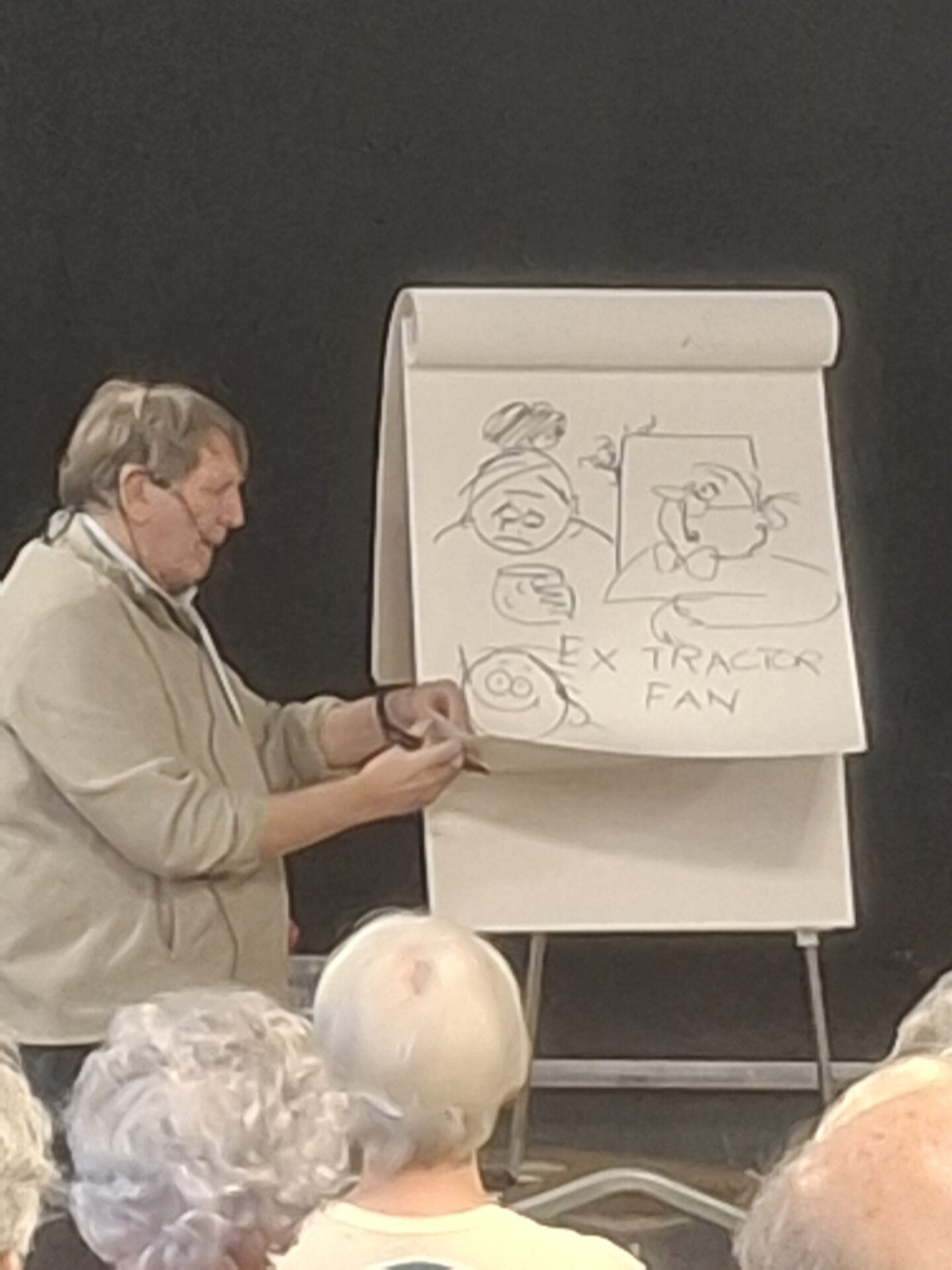
After notices regarding the new singing group and the approaching theatre visit, Janice, the Chairperson introduced Les Pickford whose presentation was entitled, ‘Cartoons and how to draw them’.
Les began by explain where the term ‘cartoon’ originated. Apparently, in 14th century Italy, painters worked for the mostpart with the church. They would initially make a drawing on paper and the lines would be pinpricked, placed on the wall and dabbed all over with charcoal. This would produce the overall design on the wall and the Italian for a piece of paper is ‘carta’, hence cartoon! In 1834, the Houses of Parliament burned down and when rebuilt, the Victorians decided to depict scenes from history. Artists drew their ideas and the magazine Punch made fun of the whole concept and produced spoof cartoons of the drawings and the word became part of English usage.
The first cartoon that Les drew was ‘Sid’. There followed a very funny story about Sid with lots of drawings and this is how he explained what was important in the drawing of cartoons.
Observation is one of the most significant aspects of this art. Les cited Giles as one of his favourite cartoonists who was a master of observation and who drew extremely accurate poses. Using authentic experience and making it recognisable in order to tell stories is key, although there are times when these experiences are embellished. Examples being the use of a mortar board to illustrate a teacher, when actually, very few teachers have ever taught in a mortar board, Vikings in horned helmets when Vikings didn’t wear them and Sherlock Holmes in a deerstalker when it’s nowhere in the books.
Stereotyping and adding props are also parts of cartoon art, like the Frenchman with a string of onions around his neck or the burglar with a mask and a swag bag or the angelic vicar with his hands together and a halo.
Exaggerated expression was next on Les’ list. The whites of the eyes are crucial as is the pucker of the cheeks and eyebrows can show so many different expressions.
Movement is also important, for example, a man jumping off a wall to the ground. The cartoonist would use whizz and echo lines and impact marks to show movement.
More comical, illustrated stories followed and the afternoon culminated in a step by step masterclass. The audience all drew a cartoon of a man who had just stepped barefoot on to a tack!
This was a highly entertaining presentation both visually and aurally with very funny stories, anecdotes and wonderful cartoons and it was enjoyed by all!
Come and join us for the meeting on 20th May at 2pm when Peter Hyde will tell us all about the ‘Mountain Rescue’. Please note, this meeting will be at a different venue. Please see the website for details.